
TLDR (too long didn’t read): What you need to know
HMRC mileage rates have increased, with the approved tax-free rate for cars and vans rising from 45p to 55p per mile for the first 10,000 business miles travelled each tax year. The change is backdated to 6 April 2026 and applies to employees and self-employed individuals who use their own vehicles for qualifying business journeys. For many businesses, this is a positive and long-awaited change that better reflects the real cost of driving for work. However, employers may need to review mileage policies, reimbursement processes and payroll procedures to ensure they are operating correctly.
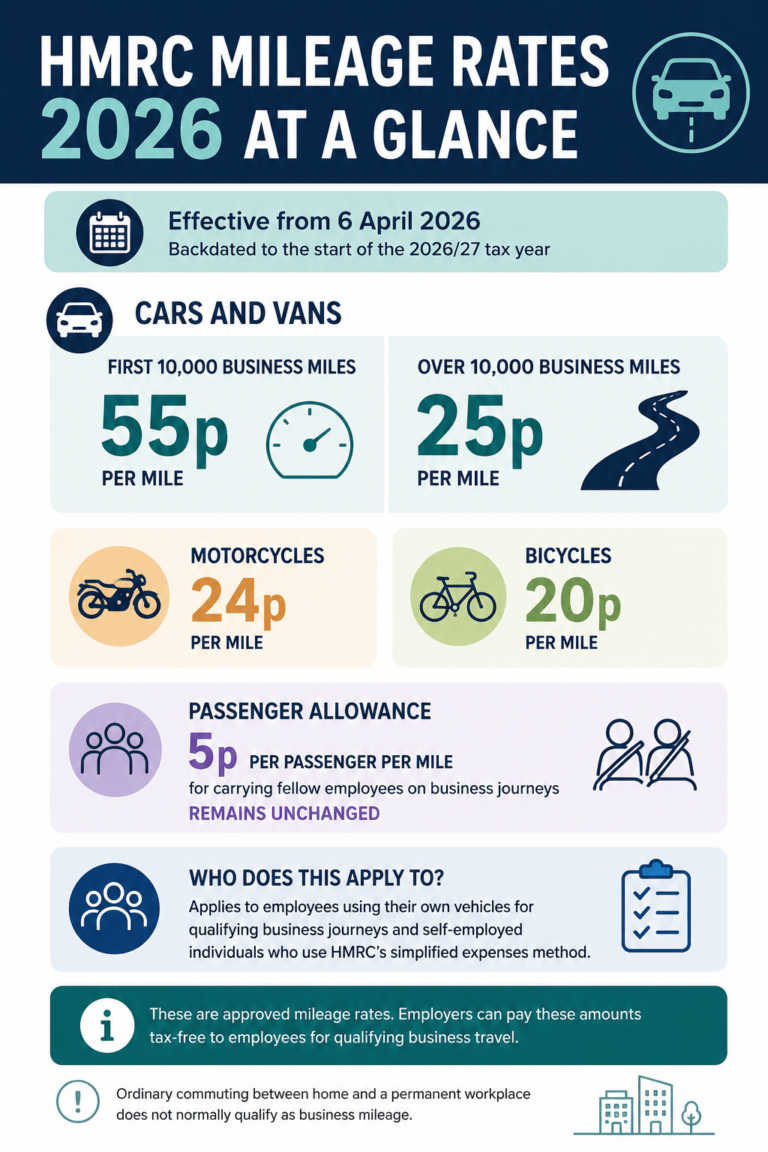
New HMRC mileage rates from 6 April 2026
- 55p per mile for the first 10,000 business miles
- 25p per mile for business mileage over 10,000 miles
- 24p per mile for motorcycles
- 20p per mile for bicycles
- 5p per passenger per mile remains unchanged
Why do the new mileage rates matter?
For many businesses, travel remains an essential part of day-to-day operations. Whether it’s meeting clients, visiting suppliers, travelling between sites or delivering services, employees and business owners often use their own vehicles for work-related journeys. The challenge is that motoring costs have changed significantly over time. Fuel, insurance, maintenance and vehicle running costs have all increased, while the approved mileage rate for cars and vans had remained unchanged since 2011.
The Government’s decision to increase tax-free mileage rates is intended to better reflect those costs and provide additional support for people who rely on their vehicles for work. For employers, the change creates an opportunity to review reimbursement arrangements and ensure employees are being compensated fairly for business travel.
What has changed to HMRC mileage rates?
The approved mileage rate for cars and vans has increased from 45p to 55p per mile for the first 10,000 business miles travelled during a tax year. The change applies from 6 April 2026 and has been backdated to the start of the 2026/27 tax year.
Vehicle type | Previous rate | New rate |
Cars and vans (first 10,000 miles) | 45p | 55p |
Cars and vans (over 10,000 miles) | 25p | 25p |
Motorcycles | 24p | 24p |
Bicycles | 20p | 20p |
The existing passenger payment of 5p per passenger per mile for carrying fellow employees on business journeys also remains unchanged.
What are approved mileage allowance payments?
The approved mileage rates are the amounts that employers can pay employees for using their own vehicles for qualifying business travel without creating a tax liability. These rates are designed to cover the costs associated with business mileage, including fuel, servicing, maintenance, insurance and general vehicle running costs.
Importantly, ordinary commuting between home and a permanent workplace does not normally qualify as business mileage. The rates apply to employees using their own vehicles for business journeys and are also relevant to self-employed individuals who use HMRC’s simplified expenses method.
Why is the increase good news for businesses?
For many business owners and employees, the increase will be welcomed. The previous 45p rate had been in place for more than 15 years, despite significant increases in motoring costs over that period. The increase to 55p per mile helps narrow the gap between reimbursement rates and the actual cost of business travel. For employers, this can support employee wellbeing and morale, particularly where staff regularly travel as part of their role. It may also reduce situations where employees feel they are personally subsidising business travel costs.
At a time when businesses continue to balance rising operating costs and recruitment challenges, ensuring travel expenses are reimbursed fairly can make a meaningful difference.
What do the new mileage rates mean for employers?
The practical impact will vary from business to business, but there are several areas worth reviewing.
Mileage policies
Employers should review existing mileage policies and reimbursement rates to determine whether any updates are required. Some businesses may already reimburse at or above the new approved rate, while others may choose to increase payments to align with the new allowance.
Payroll and expense systems
Because the change is backdated to 6 April 2026, employers may need to review mileage claims already processed during the current tax year. Businesses should also ensure payroll and expense systems reflect the updated rates where appropriate.
Budgeting and forecasting
For businesses with employees who travel frequently, reimbursement costs may increase. While the increase is relatively modest on a per-mile basis, the overall impact may be noticeable for organisations with significant business travel requirements.
What should business owners do now?
If your business reimburses mileage, consider taking the following steps:
- Review your current mileage reimbursement rates
- Check whether any claims submitted since 6 April 2026 need to be revisited
- Ensure expense management and payroll systems reflect the updated rates
- Communicate any changes clearly to employees
- Review travel and expense policies where necessary
Taking a proactive approach can help avoid confusion and ensure employees understand how the changes affect them.
FAQs
Mileage Rates 2026
When did the new mileage rates take effect?
The increase is backdated to 6 April 2026 and applies throughout the 2026/27 tax year.
Does the increase apply to all business mileage?
The 55p rate applies to the first 10,000 qualifying business miles travelled during the tax year. Mileage above that threshold remains at 25p per mile.
Have motorcycle and bicycle rates changed?
No. The approved rates for motorcycles and bicycles remain unchanged.
Do employers have to pay the full 55p per mile?
Not necessarily. Employers can choose their own reimbursement policies. However, different tax implications may arise depending on the amount paid and individual circumstances.
Can employees claim tax relief if their employer pays less than 55p per mile?
In some circumstances, employees may be able to claim Mileage Allowance Relief on the difference between what their employer pays and the approved HMRC mileage rate.
Do directors qualify for HMRC mileage rates?Directors using their own vehicle for qualifying business journeys may be able to claim mileage using the approved rates, subject to the usual rules.
Is commuting to work considered business mileage?No. Ordinary commuting between home and a permanent workplace does not normally qualify as business mileage.
Need support navigating mileage allowance changes?

The increase in HMRC mileage rates is positive news for many businesses, but it may also create practical questions around payroll, expenses and reimbursement policies.
If you’re new to Harland, book a free discovery call to explore how we can support you with values-aligned financial strategy, growth planning to fuel your impact, and advisory support that helps you make confident, well-timed decisions.
Already a client? Get in touch with your Client Manager or email info@harlandaccountants.co.uk to talk through how these changes may affect your business.