

TLDR (too long didn’t read): What you need to know
“Just” requests often sound harmless, but they can quietly drain time, profit and energy from a business. The issue is not generosity. It’s when unpaid extras become expected, repeated and unpriced. A quick answer may only take two minutes, but the value behind it often comes from years of experience. Sustainable businesses know the difference between a relationship-building gesture and bespoke work that should be scoped, priced and delivered properly. Sometimes the most profitable sentence in business is: “Of course we can help with that. We’ll put together a price for you.”

About the author: Deborah Edwards
With over 20 years’ experience, Deborah Edwards is a Chartered Accountant, business mentor and Practice Director at Harland. She works closely with purpose-led business owners to help them build financially healthy businesses, make confident decisions and create lasting impact through profit and purpose.
Why this matters for small business owners
At Harland, we work with business owners who care deeply about the quality of what they do. They want to be helpful, generous and easy to work with. Often, that is exactly what makes them so good at running purpose-led businesses. But there is a quiet challenge that affects many small business owners, especially those who trade on expertise, trust and relationships. It is the habit of giving away small pieces of value because they feel too minor to charge for.
In this month’s article, Deborah Edwards explores why the word “just” can quietly chip away at profitability, confidence and time, and why valuing your expertise is not the opposite of being generous.
The word that chips away at profit
I want to talk about a four-letter word that chips away at the profitability of thousands of small businesses every single day. It isn’t “debt”. It isn’t “cost”. It isn’t even “tax” ( three letters I know!)
It’s JUST.
If you run a business, I can almost guarantee you’ve heard it this week.
“Can you just have a quick look at this?”
“Can you just tell me the best way to do this?”
“I know I’m not a client, but could you just point me in the right direction?”
Why “just” feels harmless
The funny thing about “just” is that the person asking almost never means any harm. In fact, they’re often asking because they trust you. They know you’re knowledgeable, approachable and helpful. That’s a compliment. The problem is that “just” minimises the value of what you do. The answer might take you two minutes to give, but that’s only because you’ve spent twenty years learning it.
Every industry has its own version
I was thinking about this recently and realised that every industry has its own version.
A plumber finishes a job and hears, “While you’re here, could you just have a look at the dripping tap upstairs?”
A marketing agency hears “Can you just make one more change?”
A restaurant is asked, “Can the chef just make me something that’s not on the menu?”
An independent shop owner gets, “Could you just stay open five more minutes? I’m nearly there.”
And if you run an e-commerce business, it might be, “Could you just send me a few more photos?” or “Can you just pick me one with a bit more blue in it?”
None of these requests are unreasonable in isolation. In fact, many business owners enjoy going the extra mile. Great service is often what separates small businesses from faceless corporates. The problem comes when a hundred tiny acts of generosity become part of the service, but never part of the price.
The hidden cost of unpaid extras
As business owners, we are often our own worst enemies. We tell ourselves it will only take five minutes. We don’t want to appear awkward. We don’t want to let people down. We worry that if we charge for every little extra, we’ll lose the relationship.
But here’s the uncomfortable truth: every time you say yes to an unpaid piece of bespoke work, you are saying no to something else. You’re saying no to the paying customer waiting for your attention. You’re saying no to getting home on time. You’re saying no to spending that hour working on your own business rather than somebody else’s problem.
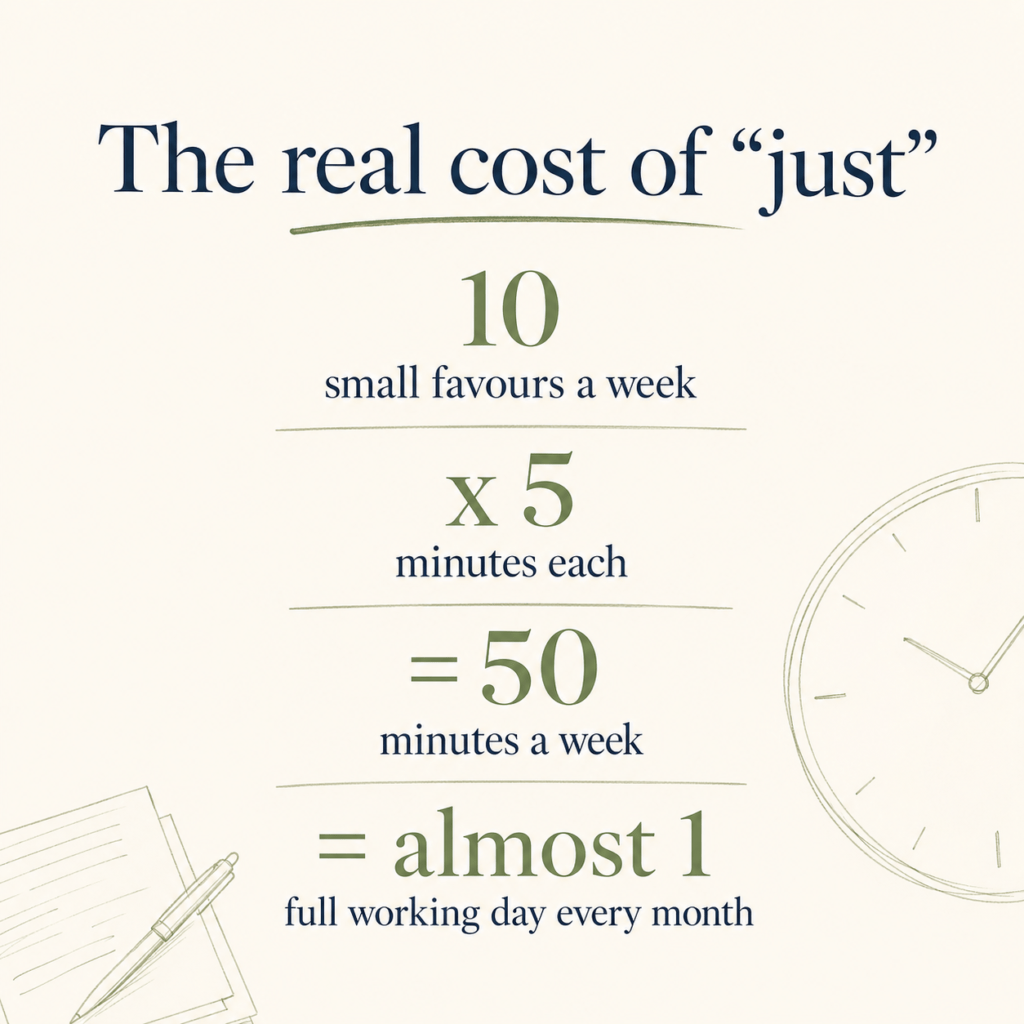
What customers often don’t see is the hidden cost. They see a quick answer. They don’t see the years of experience behind it, the training, the professional indemnity insurance, the responsibility that comes with giving advice, or the fact that ten five-minute favours every week become a full working day every month.
Being generous is not the same as giving everything away

At Harland, we genuinely enjoy helping our clients. We want to be approachable and we know that sometimes people simply need a sounding board. But we also know that sustainable businesses have to protect their time and value their expertise.
There is a big difference between being generous and building a business model around free work.
The best businesses I know are not the ones that carefully balance favours. They are the ones that know the difference between a relationship-building gesture and a bespoke service that should be scoped, priced and delivered properly.
The pause that protects your business
So perhaps the next time you hear the words, “Could you just…”, pause for a moment. Ask yourself whether it really is a quick favour, or whether it’s something that deserves the same professionalism and value as every other part of your service. Because the four-letter word keeping many businesses poor isn’t “debt” or “rent” or “cost”.
It’s “JUST”.
And sometimes the most profitable sentence in business is not “yes”, but: “Of course we can help with that. We’ll put together a price for you.”
Want to build a more financially healthy business?

If you’re ready to protect your time, strengthen your profitability and make more confident decisions, we’d love to help. At Harland, we work with purpose-led business owners who want to build financially healthy businesses that create positive impact. Book a discovery call to find out how we can support you.